

Textile architecture: concept and structural stability
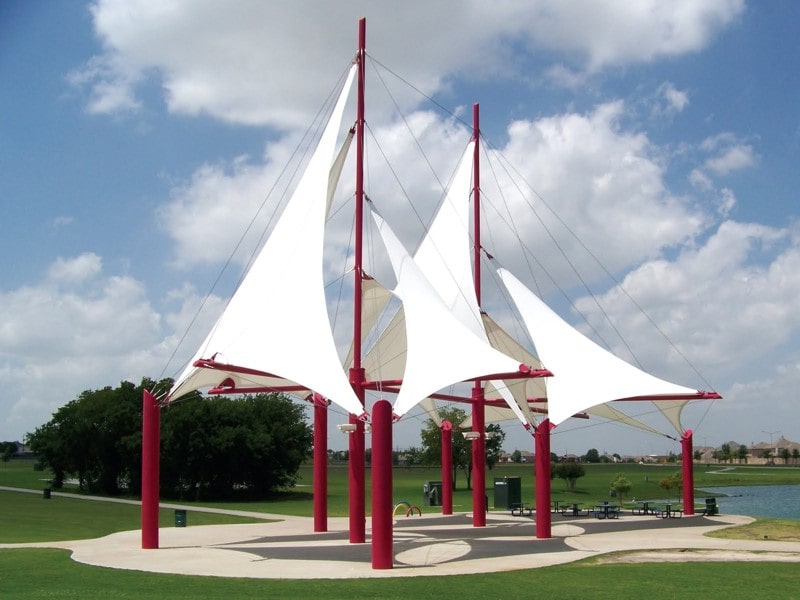
Every day, buildings pop up using fabric to shape spaces in cool ways called textile architecture. These fabric structures bend and sway like they’re dancing in the wind, adding a fun vibe everywhere. They don’t just look good—they’re cheaper and faster to build than regular walls, saving tons of cash and time. Imagine a big pavilion that goes up in a flash or a stadium roof that feels light as a feather; that’s the power of this clever design. This style is catching on fast, especially for folks who want fresh, eye-catching places without breaking the bank. Keep reading, and you’ll see how fabric can flip the script on boring buildings and why everyone’s buzzing about this fresh way to build.
Textile architecture is any architectural solution that uses fabric as the main material, both in the definition and in the wrapping of living spaces. Textile structures provide wide and aesthetic closings of great variety in terms of shapes. One of the main advantages of the use of fabric as an enclosure or covering material is the permeability of light to the interior of the structure, which provides high general levels of natural light to the living spaces located inside.
The textile structures are of constant thickness and flexible and deformable nature, but require a small number of rigid elements as support and tension to the textile load. Traditionally, we find examples of textile structures in well-known figures, such as the tents of nomadic peoples or the sails of boats.
However, the origins of our contemporary technology of textile structures are to be found in the 19th century. The mechanization of spinning and weaving after the industrial revolution made it possible to create large portable tents for the tents of travelling circuses, which were very abundant in the latter part of that century.
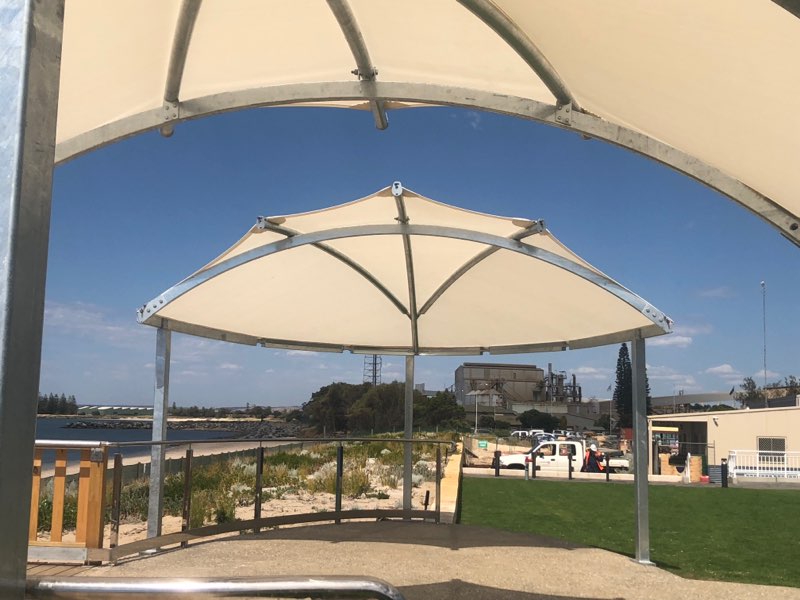
The basis of its formal and functional design lies in its structural stability, which requires the maintenance of permanent tensile stress in the material – the fabric – which can be achieved in two ways:
- By applying tensile stress from the perimeter, or from intermediate points or lines. This is what is known as tensile-tensioned textile structures. The tensioning mechanism of these structures is roughly assimilated to that of the fabric of an umbrella.
- By applying perpendicular and continuous air pressure to the entire surface, in what are known as swollen structures. The tension mechanism of these structures is similar to that of a beach mattress.
The shape and physical behaviour of textile structures differs greatly from the conventional, rigid, “linear elastic” gantry structures used in most buildings. There are three fundamental structural factors in a textile structure: surface shape, pre-stressing levels and surface deformability.
Surface shape
Most contemporary textile structures are based on an “anticlastic” surface geometry, i.e. a structure that is solely tensile, without bending or compressive stresses. It is a set of “arched” tensile elements that act in opposition to a similar set of “hanging” elements, i.e. there is a series of upward and downward forces that end up at the edge and at the fastening points.
Physically, the two sets of elements represent the two directions of the textile yarn (the weft and the warp) inside the membrane. This configuration has a valuable property, because it can be pre-stressed in its entirety without significant changes in its overall shape.
Prestressing
Prestressing contributes significantly to the rigidity of a membrane because its various curvatures interact to retain what would otherwise be significant deformations. The deformation of the “hanging” curvature due to the different stresses on the structure is retained by the “arc” stresses. The actual prestress values used in practice usually represent a small proportion of the ultimate strength of the membrane.
The prestressing level can also be set in such a way that loss of tension in both directions is avoided in a special area of the surface under the applied load. Such values are usually set in combination with the selection of the shape.
Deformability
Unlike the more conventional modes of building construction, deformability is considered to be a useful and important characteristic of textile structures.
In fact, due to their relatively low surface stiffness, both in-plane and out-of-plane, changes in shape are a primary response of the textile structure to externally applied loads, in conjunction with changes in stress distribution across the surface. In addition, the deformations that develop in the membrane material are, in several respects, greater than those of steel, for example.
Consequently, much greater deformations and geometrical changes occur in textile structures under load than in conventional portal constructions. The overall stability is ensured by adequate flexibility of the membrane supports as well as by the deformability of the membrane.